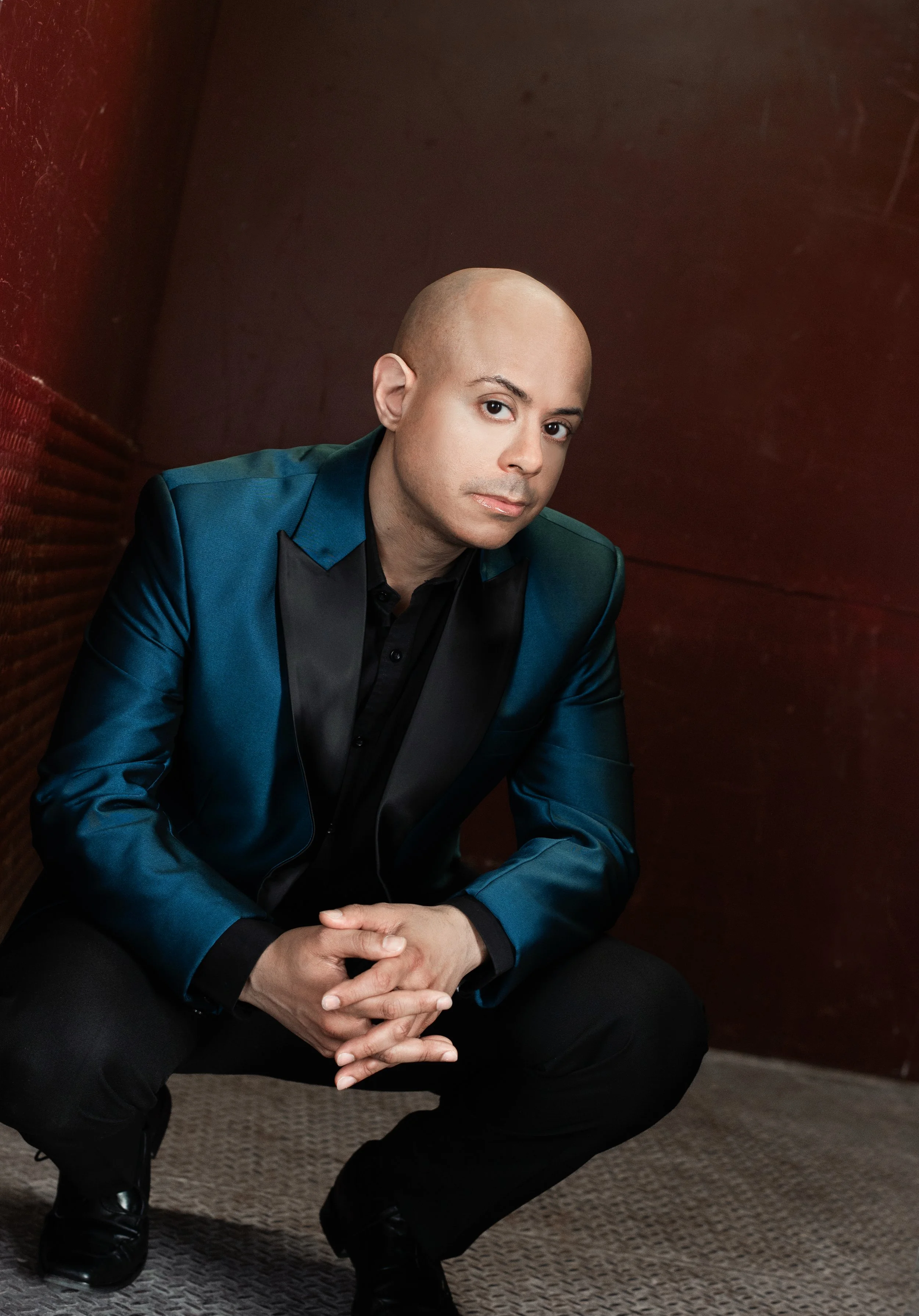
Biography
Stewart Goodyear is a composer-pianist in the rarest tradition — an artist who writes the music, performs it at marathon scale, and plays every note as though he made it his own. Proclaimed “a phenomenon” by the Los Angeles Times and “one of the best pianists of his generation” by the Philadelphia Inquirer, he belongs to a line that runs from Beethoven through Liszt, Rachmaninov, and Bartók: musicians who composed the repertoire and performed it themselves. Born in Toronto to a Trinidadian mother and a British father, Goodyear carries two worlds into that tradition — and a voice unmistakably his own.
That voice is most fully realized in his own music. His suite for piano and orchestra, Callaloo — named for the word Trinidadians use for their own cultural mix — fulfilled a dream he had held since the age of fourteen: to bridge the classical and calypso worlds of his heritage; Orchid Classics released it alongside his piano sonata. His commissions reach across orchestra, chamber ensemble, and solo instrument — recent works for the Chineke! Orchestra, a Piano Quintet (Hommage à Beethoven) for the Penderecki String Quartet, a piano work for the Honens International Piano Competition, the solo-violin suite Solo for Miranda Cuckson, and The Kapak for cellist Inbal Segev. As a transcriber, he rebuilt Tchaikovsky’s complete Nutcracker for solo piano — a recording The New York Times named among the best of 2015 — and in performance he improvises his own cadenzas, approaching every score through the eyes of a composer.
Goodyear is known, too, for building performances at a scale few attempt. His Sonatathon — all 32 of Beethoven’s piano sonatas in a single day — has been mounted at Koerner Hall in Toronto, McCarter Theatre in Princeton, the Mondavi Center, the AT&T Performing Arts Center in Dallas, and beyond. He has recorded the complete sonatas and the complete concertos; of the sonatas, Anthony Tommasini wrote in The New York Times of “a remarkable achievement… pristine technique, infectious energy and fascinating attention to detail.” Few pianists take on the complete Beethoven cycles at all; fewer still have made them the spine of a career — a spine that extends into the current season, when he performs the complete concerto cycles with Orchestra Iowa and the Louisville Orchestra, the latter (in April 2027) a summit of the calendar that confirms his standing among the foremost Beethoven interpreters at work today.
A Steinway Artist, Goodyear has appeared as an orchestral soloist with the New York Philharmonic, the Chicago Symphony, the Philadelphia Orchestra, the Cleveland Orchestra, the Los Angeles Philharmonic, and the San Francisco Symphony, among many others across North America, Europe, and Asia. His discography spans the complete Beethoven sonatas and concertos, concertos of Tchaikovsky, Grieg, and Rachmaninov — the last a Juno nominee — an album of Ravel, and For Glenn Gould, drawn from Gould’s U.S. and Montreal debut programs, on labels including Orchid Classics, Steinway & Sons, Naxos, and Analekta.
He trained at the Glenn Gould School of Toronto’s Royal Conservatory of Music, graduating at fifteen, then at the Curtis Institute of Music — where he studied with Leon Fleisher, Gary Graffman, and Claude Frank — and the Juilliard School, where he took a master’s in piano performance. The current season also brings him to the Calgary Philharmonic and the Annapolis, Arkansas, Colorado, Mobile, Northwest Florida, and South Bend symphony orchestras; recitals at Houston’s DACAMERA, Telluride Chamber Music, and Toronto’s Koerner Hall; a new collaboration with Imani Winds on a commissioned quintet and sextet; a recording with the Wisconsin Chamber Orchestra; and performances of his own Music in a Time of War with the Experiential Orchestra. Across marathon, concerto, and premiere alike, Goodyear plays to reach the whole room — the instinct of an artist who wants classical music to belong to more people, not fewer.